Is CrossFit Safe for Beginners, and How Do Coaches Scale the Workouts?
Anyone who's watched a few clips of CrossFit competitions will have the same question: is CrossFit safe for beginners? The honest answer is that it can be, if the coaching is good and the workouts are scaled to you. The risk comes from intensity without technique, and that's something worth understanding before you try it.
Quick answer: CrossFit-style training can be safe for beginners when technique comes first and a coach scales every movement. POWER classes at HIIT West Hampstead need no prior CrossFit experience.
What 'Safe' Really Depends On
CrossFit is demanding. High-intensity functional movements, lifting and conditioning can increase the risk of injury if they're done incorrectly, and beginners or anyone with an existing injury should take care. Some people also find unsupervised CrossFit-style workouts too intense without proper guidance.
The first rule is that technique comes first and intensity comes second. A coach who lives by that, and who will happily tell you to slow down or lighten the load, makes the difference between a good session and a bad one.
The NHS advises speaking to your GP first if you haven't exercised for some time or have a medical condition ( NHS guidelines).
How Our POWER Classes Work
Our CrossFit-style POWER classes run every Friday and Sunday at 5pm and are included in your HIIT membership. Each session is split into four training zones, so you're never doing one thing for the whole class. No prior CrossFit experience is needed, and coaches tailor each session to your level.
How Coaches Scale Each Zone
POWER class zones and how they scale
| Zone | What it involves | How a coach might scale it |
|---|---|---|
| Compound lifting | Squats, deadlifts and presses with a barbell | A lighter bar, a lighter load or a different variation until your technique is solid |
| Conditioning | Intervals on rowers, bikes, sleds and battle ropes | Shorter work periods, longer rests and a pace you can hold |
| AMRAP (as many rounds as possible) | Circuits that test your work capacity | Fewer reps per round and swapping harder movements for simpler ones |
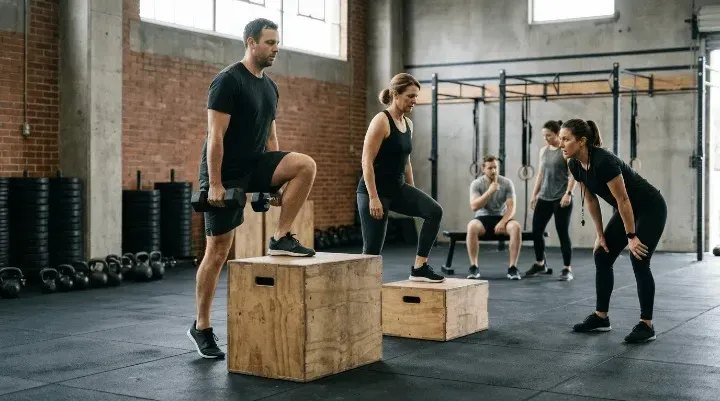
| Plyometric bodyweight | Burpees, box jumps and alternating lunges | Step-ups instead of jumps, or lower-impact versions of each movement |
What Scaling Looks Like in Practice
Scaling isn't a punishment. Trainers provide alternative movements so every participant can work at a suitable intensity and reduce injury risk, and it's completely normal for two people in the same class to be doing different versions of the same exercise. Someone new might lift a light bar while a regular loads up heavier plates. You're working at the same effort, not the same weight.
If you have an injury or a niggle, tell the coach before the class starts. They can change the plan, and it's far easier to do that at the beginning than halfway through a set.
Tips for Your First Class
Arrive a few minutes early, so the coach can talk you through the plan. Start lighter than you think you need to, because you can always add weight next time. Focus on how the movement feels, not how it looks next to the person beside you. Rest when you need to. And don't judge yourself by how you feel in the first ten minutes, because a lot of people find the warm-up harder than the workout.
Is CrossFit Better Than the Gym?
It depends on your goals. CrossFit-style training is ideal for functional fitness, fat loss and the motivation of group sessions, while a traditional gym suits solo strength work or cardio. Many people get the best results combining both. If you want more detail, our beginner's honest guide to CrossFit goes through it.
Where to Start
If CrossFit sounds appealing but scary, begin with a couple of regular HIIT classes so you're comfortable with the equipment and coaching style. Our guide to functional fitness workouts is a useful companion.
Signs You Should Slow Down
Sharp or sudden pain, dizziness, or a movement that feels wrong rather than just hard are all reasons to stop and tell the coach. Muscle burn and heavy breathing are part of training. Joint pain is not. If something doesn't feel right, rest and ask for an alternative, because a good coach would much rather adjust the plan than see you push through.
Do You Need to Check With Anyone First?
If you have an existing injury, a medical condition or you're returning after a long break, it's sensible to speak to your GP before starting any high-intensity programme. Then tell the coach what you've been told, so they can plan around it. Starting well is far better than starting fast.
What Our Coaches Look For
In a first class, a coach is watching for a few simple things: whether you can hold a good position under load, whether your breathing is under control and whether you're moving the same way in the last round as in the first. When form starts to slip, the answer isn't to push harder, it's to lighten the load or shorten the round. That habit, more than any piece of kit, is what keeps beginners safe.
It also means you're allowed to progress at your own pace. Plenty of members spend their first few weeks on lighter loads, then move up once the movement feels natural.
When you're ready, book a POWER class through the timetable, or begin with a Kickstart to try four sessions for £39.
Frequently Asked Questions
What is the first rule of CrossFit-style training?
Technique comes first and intensity comes second.
Do I need CrossFit experience to join?
No. Coaches tailor each POWER session to your fitness level.
When are POWER classes?
Every Friday and Sunday at 5pm, included in a HIIT membership.
Try CrossFit-Style Classes Safely, Even as a Beginner
POWER classes run every Friday and Sunday at 5pm and are included in your HIIT membership. Start with a 2-Week Kickstart.
Start Your Kickstart