Is HIIT or Running Better for Losing Fat?
You've typed some version of HIIT vs running fat loss into Google, hoping for a clean answer. What you get instead is a pile of listicles that all land on "it depends," which is true, but not exactly useful when you're standing by the front door deciding whether to go for a run or get to a class. Here's the actual answer, plus the part most of those articles skip over.
What Actually Burns Fat, Not Just Calories
Fat loss comes down to a calorie deficit over time. That part isn't really up for debate. What's less talked about is that HIIT and running create that deficit in different ways, and the difference matters more once you factor in what happens after you've stopped moving.
How HIIT Burns Fat, and Keeps Burning After You Stop
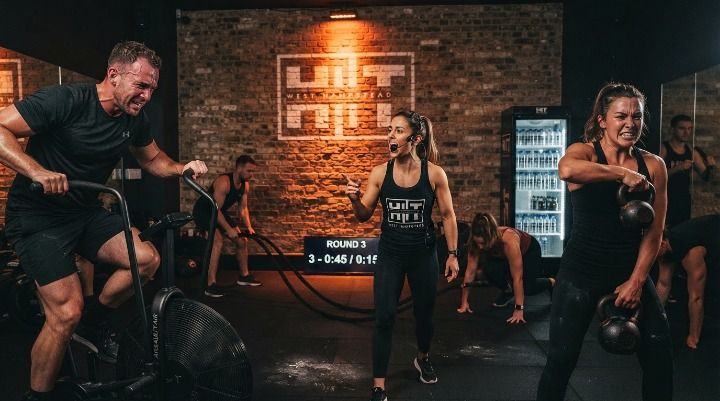
HIIT alternates short bursts of maximum effort with brief recovery windows, which pushes your body into a state it has to work hard to recover from. That recovery process has a name: EPOC, or excess post-exercise oxygen consumption, better known as the "afterburn" effect. We've gone deeper on EPOC elsewhere on this site, but the short version is that your body keeps burning calories at an elevated rate for hours after the session ends, not just while you're in the room.
At HIIT West Hampstead, classes are built around exactly this. A 45-minute session can burn up to 1,000 calories, and the afterburn effect keeps that number climbing for roughly 24 hours afterwards. That's the part a simple calories-per-mile comparison with running completely misses.
How Running Burns Fat
Running is steady-state cardio. You hold a consistent effort for a sustained period, and your body pulls mostly from aerobic energy systems to fuel it. It's simple, it costs nothing beyond a decent pair of trainers, and there's a reason it's stayed popular for about as long as humans have had shoes.
The trade-off is time. Running burns real calories, but minute for minute, a hard interval session generally asks more of your body than a steady jog does. To match the calorie burn of one HIIT class, you'd typically need to run for a good while longer, and running on its own doesn't create the same afterburn effect once you stop.
HIIT vs Running: Side by Side
Neither one is objectively better. They're built for different things, and the table below is really about which set of trade-offs suits you.
| HIIT | Running | |
|---|---|---|
| Session length | 45 minutes | Often 30–60+ minutes for a comparable calorie burn |
| Afterburn effect | Significant, up to 24 hours | Minimal once you stop moving |
| Equipment/skill | None needed, coach-led | None needed, though pacing affects efficiency |
| Joint impact | Lower, when programmed well | Higher, from repetitive impact over distance |
| Muscle retention | Better, thanks to resistance elements | Can reduce muscle mass if overdone without any strength work |
| Best for | Time-poor people wanting maximum return | People who enjoy longer, steadier sessions |

Where Running Still Wins
This isn't a running pile-on. If you genuinely enjoy it, that counts for more than any of the numbers above, because the workout you'll actually stick to always beats the one that's theoretically more efficient. Running also builds a solid aerobic base, and plenty of people use it for headspace as much as fitness. That's a real benefit a stopwatch can't measure.
Try a coach-led HIIT class and feel what the afterburn effect actually does.
So Which Should You Actually Do?
If fat loss is the main goal and your time is limited, HIIT has the edge, largely because of the afterburn effect and the fact that most people can't replicate that same intensity alone on a run without a level of self-discipline that's hard to find on a wet Tuesday evening. If you've got the time and you enjoy the process, running works too, especially paired with two or three strength sessions a week so you're not just burning calories, you're also protecting the muscle underneath them.
The answer nobody really wants to hear: consistency beats optimisation. The "better" workout is the one you'll actually turn up for four times this month, not the one that wins an argument on paper.
How HIIT Classes at HIIT West Hampstead Work
If you decide HIIT's the better fit, here's what that looks like in practice. Classes run for 45 minutes and alternate maximum effort with short recovery windows, the same interval structure covered above. There are several formats depending on what you fancy that day, including Energy, Strength, Circuits, TRX and Abs, so it doesn't turn into the same class on repeat. Everything is coach-led, so you're not guessing at form while trying to hold your heart rate up.
You can check current pricing or start with the 2-week Kickstart if you'd rather try a few sessions before committing to a membership.
FAQ
Common questions about HIIT vs running for fat loss.
Is HIIT or running better for weight loss?
Both create a calorie deficit, which is what ultimately drives weight loss. HIIT's afterburn effect means you keep burning calories for hours after the class ends, which running alone doesn't replicate to the same degree.
How many HIIT sessions a week are enough for fat loss?
Two to three sessions a week is a sensible starting point, with rest or lighter activity on the days in between.
Can I combine HIIT and running?
Yes, and many people get the best results this way: HIIT for the afterburn effect, running for aerobic base and headspace.
Is HIIT bad for your joints?
Well-programmed HIIT is generally lower-impact than distance running, though any high-intensity training should be scaled to your current fitness level and built up gradually.
Do I need to be fit to start HIIT?
No. Coaches adjust intensity for whoever's in the room, so beginners and more experienced members can train in the same class.