Core Strengthening Exercises for Beginners: A Guide to Building Core Strength, Stability, and Full-Body Control

Hema Shah • January 17, 2026

The ultimate goal of HIIT West Hampstead is to improve fitness and posture while decreasing the chances of injury by developing a solid core. At HIIT West Hampstead we provide confidence and control through our training, and this Core Workout Guide will give you a good foundation on how to effectively build up your core and allow yourself to continue to progress without fear of injury or anxiety.
What Exactly is Core Strength?

What Exactly is Core Strength?

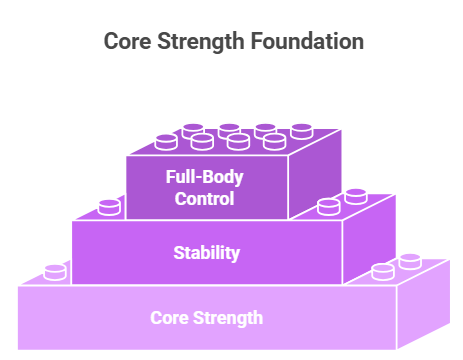
When most people think about their "core", they usually think about their abdominal muscles. There is, however, much more to a person’s core than just their abs. The core includes the muscles that help stabilise your body and balance; these include the abdominal muscles, lower back muscles, hip muscles and the pelvic floor muscles. These core muscles all work together to give you the control needed for proper body positioning and body control, making it easier for you to move safely in all areas of your life. A strong core will help you maintain better balance, decrease your back pain, and improve your overall performance in workouts.


For those just starting out, focusing on core stability training helps establish proper movement patterns before progressing to more advanced exercises. A strong core acts as a centre of power for your entire body.


Getting Started The Right Way

For beginners who want success with core-strengthening exercises, the main things to concentrate on are proper technique and starting out slowly. You do not want to rush through these exercises and do them carelessly – instead, concentrate on taking your time with each exercise and using controlled movement when doing each one of them. When doing so, you will recruit the appropriate muscles effectively. Additionally, pay close attention to your breathing: exhale on the hardest part of each exercise and be able to breathe evenly during the workout.


HIIT West Hampstead encourages beginners to focus on doing fewer sets with better form and technique rather than trying to do more reps with poor form. It is better to have shorter but consistent workouts than to have a session of very long workouts with poor technique.


Essential Core Strength Exercises

To provide a balanced beginner’s workout to develop the core, all regions of the core need to be included in a beginner programme. Some good examples of a beginner's core workout include:


  • Plank Holds – A great exercise to engage your full core and improve both endurance and postural strength.
  • Dead Bugs – An excellent exercise for learning how to properly coordinate the arms and legs while keeping the body stabilised in a neutral position.
  • Glute Bridges – An excellent way to strengthen the lower back and hips, as well as stabilise the pelvis.
  • Bird Dogs – This exercise is very helpful in developing balance as well as assisting with developing control of the core during movement.


All of these core strengthening exercises can be modified based on your individual level of fitness, allowing a beginner to progressively build strength.


Progressing Safely and Effectively

Once you've developed more confidence in performing core workouts, you'll start to want to increase the challenge of those exercises. You can do this by:


- Extending your hold times 

- Adding more reps

- Incorporating light resistance 


When progressing to a more challenging version of a core strength exercise, always remember to do so gradually. Beginners often make the mistake of trying to increase the difficulty of a core exercise too quickly. This can lead to an increased risk of injury and also create poor movement patterns.


By consistently performing core strength exercises 2-3 times a week, your body is allowed to adjust to the increased load, thus minimising the chance of injury.


By incorporating your core strength workouts into your overall full-body training programme, you create an increased degree of strength and improved coordination between all muscle groups.


Core Training for Everyday Life

Developing a strong core will make you feel better equipped to do all the things that you do in everyday life outside of the gym.

Carrying groceries, sitting at your desk, etc., all require the use of your core, so when you perform core strengthening exercises on a regular basis as a beginner, you will also develop better posture, balance, and confidence in your ability to move around day-to-day.


At HIIT West Hampstead, our experienced trainers will support you every step of the way as you work to create strong and healthy core habits to use in your everyday life, not just during your workout.


Frequently Asked Questions

How many days should a beginner train their core?

The recommended amount for training the core is two to three times a week. This provides sufficient stimulus to the muscles in order to build strength as well as allow for recovery time.


Can a beginner do core strength training without equipment?

Yes, there are many types of core strength training that are fully accessible and usable for beginners. Many exercises use just your body weight as resistance, so no equipment is needed.


How long should a beginner's core training session last?

A session of focused core training for a beginner can be performed within a period of 15 to 25 minutes. The success of the workout depends on performing all exercises using good form and control at all times.


Does core training reduce lower back pain?

When core stability training is completed correctly, it will stabilise the spine and lower the risk of experiencing lower back discomfort.


Is core training suitable for complete beginners?

Yes, it is absolutely possible for complete beginners to begin doing core-strengthening exercises. With guidance through the process of learning and preparing to progress, the exercises will be safe for them to do.


By focusing on maintaining regular training for a core workout, using good form and control while performing all the exercises, and taking progress gradually, beginner athletes can develop a solid foundation of core strength that will benefit their fitness goals as well as their day-to-day lives. For structured guidance and expert assistance, HIIT West Hampstead has beginner-level training available to assist you with building strength and improving your overall comfort in movement as well as preventing injury.
Get Directions


By HIIT Gym April 18, 2026
Whether you are a seasoned gym-goer or someone looking to kickstart a fitness journey, High-Intensity Interval Training (HIIT) has likely crossed your radar. It’s the "gold standard" of efficient exercise, designed to get you maximum results in minimum time. But what exactly happens when you swap the solo treadmill slog for a structured HIIT class? From metabolic shifts to the "afterburn" effect, here is how a HIIT class actually changes the game when you bring a bit of "humanzee" spirit to the floor. 1. It’s the Ultimate Time Hack Let’s be real: nobody wants to spend two hours on a treadmill staring at a wall. HIIT is for the person who wants to get in, smash it, and get out. By red-lining your heart rate for 30 minutes, you’re doing more for your metabolism than an hour of "jog-chatting" ever could. It’s efficiency at its finest. 2. The "Afterburn" is No Myth In the world of science, we call it EPOC (Excess Post-exercise Oxygen Consumption). In human terms? Your body is so shocked by what you just did that it keeps burning fuel for hours while you’re sitting on the sofa later. You’re literally turning your body into a furnace that doesn't switch off the moment you leave the studio. 3. High-Octane Calorie Shredding If you’re looking to shift some weight, HIIT is the heavy hitter. Because you’re alternating between "all-out" effort and "active recovery," your body burns through calories at an accelerated rate. It’s a high-intensity shock to the system that forces your fat stores to take notice. 4. Building "Functional" Muscle We aren’t talking about "show muscles" that look good but do nothing. HIIT builds the kind of lean, explosive muscle you actually use in real life—whether that's sprinting for a train or carrying all the grocery bags in one trip. You’re preserving muscle mass while torching the fat covering it. 5. Heart Health for the Long Run HIIT pushes your cardiovascular system to its limits, which sounds scary but is actually brilliant for your heart. It improves your VO₂ max (how well you use oxygen) faster than almost any other form of training. It’s like giving your heart a regular "software update." 6. No Equipment? No Problem One of the best things about HIIT classes is their versatility. While many studios use weights or rowers, the core of HIIT can be done using just your body weight. This makes the skills you learn in class highly transferable to home workouts or hotel rooms when you’re travelling. 7. No Boring Gear Required You don't need a basement full of expensive equipment to get a world-class workout. Most HIIT classes focus on bodyweight movements—squats, lunges, burpees, and planks. Once you learn the flow, you have a "portable" gym in your own head that you can take anywhere in the world. 8. A Natural Growth Hormone Kick High-intensity training triggers a massive spike in Human Growth Hormone (HGH) . This isn't just about muscle; HGH is the body's natural "fountain of youth" that helps with cell repair and fat loss. It’s basically a natural anti-ageing treatment delivered via sweat. 9. The Power of the Pack There is something deeply human about suffering together. When you’re in a class, the collective energy keeps you honest. It’s much harder to quit halfway through a set when the person next to you is digging deep. You feed off that atmosphere, pushing yourself further than you ever would solo. 10. Regulation of Blood Sugar Instead of just "going through the motions" on a bike for an hour, HIIT forces your body to get its act together. It attacks insulin resistance head-on, making it far more effective than old-school, steady-state cardio. If you’re serious about keeping your blood sugar in check or telling Type 2 diabetes to jog on, you need that raw, high-intensity grit—it’s the most efficient way to shock your metabolism back into peak performance. The Bottom Line: HIIT isn't about being perfect; it's about being intense. It’s about showing up, working hard, and tapping into that raw human potential. Your future self will definitely thank you for it.
By HIIT Gym April 13, 2026
Walking into a gym for the first time - or even the fiftieth - can feel overwhelming. The right gym membership isn't just a financial commitment. It's a promise you make to your future self. Let's be honest: most of us have signed up for a gym membership with the best of intentions, only to watch our attendance fade like a New Year's resolution by February. The problem usually isn't willpower. It's the misalignment between what the gym offers and what your actual life looks like. This guide helps you close that gap. Start with your "why" - not the price tag Before you even step foot inside a gym, get brutally honest with yourself about what you're trying to achieve. Weight loss, muscle gain, stress relief, athletic training, or simply building a lifelong movement habit - each of these calls for a different environment. A gym membership that's perfect for a powerlifter may be a terrible fit for someone who wants calm, guided yoga sessions. Strength training Look for free weights, squat racks, and a serious lifting culture. Mind-body balance Studios with yoga, pilates, or meditation classes are your sweet spot. Cardio & endurance Treadmills, bikes, pools — and ideally, group run clubs. General fitness A large, full-service gym with varied equipment suits you well. Location matters more than you think Research consistently shows that people are far more likely to use a gym that's close to their home or workplace. A fancy, fully-equipped facility 40 minutes away will lose to a modest one 10 minutes from your office every single time. When evaluating your next gym membership , treat location as a non-negotiable filter — not an afterthought. Pro tip: Do a trial commute to any gym you're seriously considering — at the time of day you'd normally work out. Traffic, parking, and walking distance feel very different at 6 a.m. versus noon. Decode the contract before you sign The fine print of a gym membership contract is where dreams go to die quietly. Always ask these questions before committing: Is this a month-to-month or annual contract? What are the cancellation terms? Are there initiation or enrolment fees on top of the monthly cost? Can I freeze my membership if I travel or get injured? Are classes, personal training, or guest passes included — or billed separately? Does pricing change after the first year? "The best gym is the one you'll actually go to. The best membership is the one that fits your real life — not your ideal life." Trial periods are your best friend Most gyms offer a free day pass or a short trial. Use it — and use it at peak hours. A gym that feels spacious on a Tuesday afternoon can feel claustrophobically crowded at 6 p.m. on a Wednesday. Your gym membership experience will be defined by those peak-hour visits far more than the quiet midday ones.i During your trial, pay attention to cleanliness, equipment availability, staff friendliness, and the general vibe. Do the other members look like people you'd feel comfortable around? Does the energy motivate you, or does it stress you out? These sensory details matter enormously for long-term adherence. Think community, not just equipment One underrated factor in choosing a gym membership is the human element. Group fitness classes , personal trainers, and even regular gym-goers you recognise can become powerful accountability mechanisms. A gym that fosters community tends to keep members longer and produces better results. Boutique studios often excel here — SoulCycle, CrossFit boxes, and local Pilates studios frequently build tight-knit communities. Larger commercial gyms offer anonymity, which some people prefer. Know which type of social environment fuels you. When to choose a specialised gym Sometimes, the right answer isn't a general gym membership at all. Rock climbers, martial artists, swimmers, and competitive athletes often benefit far more from sport-specific facilities. If you have a clear athletic passion, lean into it — you're more likely to train consistently in an environment built around something you love. Choosing a gym membership is ultimately an act of self-knowledge. The more clearly you understand your goals, your schedule, your social preferences, and your financial reality, the easier the decision becomes. Don't rush it. Take the trials, read the contracts, do the commute test — and then commit fully to the environment that gives your best self the best chance to show up.
More Posts