Hyrox Classes Near Me: How to Pick the Right Training Programme
You've probably noticed Hyrox popping up everywhere lately, on Instagram, in gym window decals, in the fitness section of every "trends to watch" list. So you search Hyrox classes near me , and you get a wall of results that all sound identical: strength, endurance, community, results. None of it tells you what actually separates a class worth your time from one that's borrowing the name for search traffic.
This isn't another "what is Hyrox" explainer. We've already covered what Hyrox is and how to prepare in detail. This is the practical bit: how to tell a genuine Hyrox programme from a class that's just wearing the label, what to look for at each stage of training, and who actually benefits from turning up.

A Quick Refresher on What Hyrox Involves
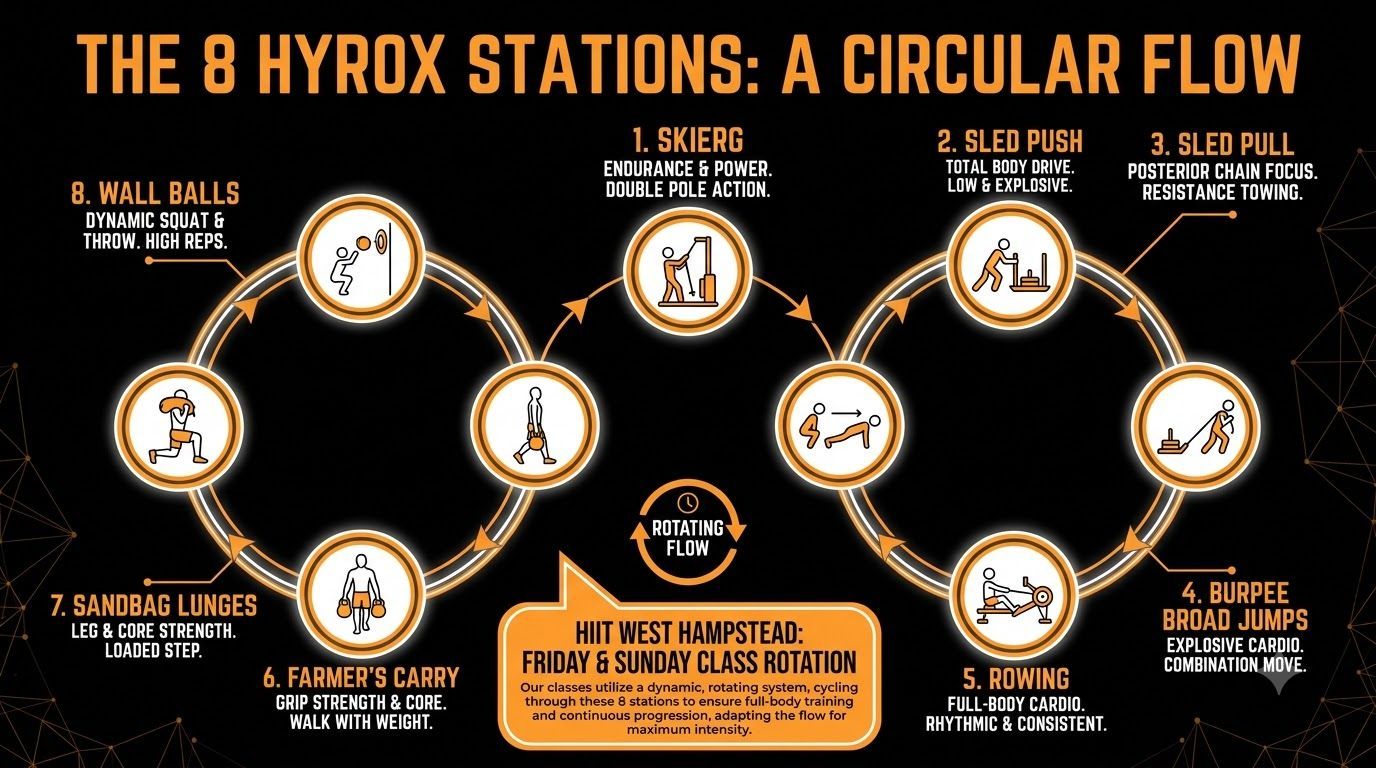
Every Hyrox race follows the same structure wherever it's held: run 1km, complete a station, repeat eight times. Eight stations, eight 1km runs, 8km of running total. The stations are fixed (SkiErg, sled push, sled pull, burpee broad jumps, rowing, farmer's carry, sandbag lunges, wall balls), with the exact loads and rules published on the official Hyrox race format page. If you want the full breakdown of the format and how race day actually unfolds, that's already covered elsewhere on this site. Here, we're focused on choosing a class that trains you for it properly.
Genuine Hyrox Training vs. a Class That's Just "Labelled" Hyrox
This is the bit most people never think to check. A lot of gyms have started calling their circuit classes "Hyrox" because the keyword gets searches, not because the session was built around the race. The difference matters more than it sounds like it should.
| Genuine Hyrox Programming | A Circuit Class With a Hyrox Label | |
|---|---|---|
| Station practice | Trains the actual eight stations at race-relevant loads | Uses generic kit: dumbbells, bands, bodyweight |
| Running integration | Combines running with stations, the way the race does | Running and strength are trained separately, if at all |
| Race simulation | Builds toward full or partial race simulations before an event | No simulation, no pacing practice |
| Coaching focus | Coaches know the ruleset and correct technique on sled work, wall balls, lunges | Coaches run a general HIIT format regardless of the name on the timetable |
| Progression | Structured build across weeks, adjusted as race day approaches | Same format every week, no periodisation |
If a class ticks the right-hand column, it might still be a decent workout. It just isn't Hyrox training, and it won't prepare you for the actual event.
What to Look for in a Genuine Hyrox Training Programme
Three things separate real Hyrox programming from everything else:
- Station practice at race-relevant weights. Sled pushes and wall balls feel completely different under fatigue at the correct load compared to a lighter, gym-friendly version.
- Running intervals that mirror race pacing. Not just "go for a run." Intervals and tempo work aimed at holding a sustainable pace across 8km, broken up by strength efforts.
- Race simulation sessions. As an event gets closer, sessions should start stringing stations and runs together, so your body has felt something close to the real thing before race day does.
Training Frequency: 12 Weeks Out vs. 4 Weeks Out
How much and what kind of training you need changes a lot depending on where you are in your build-up. Most people get this wrong in one of two directions. Either they panic-train in the final month, or they coast early and cram late.
| Timeframe | Focus | Suggested Frequency |
|---|---|---|
| 12 weeks out | Building your aerobic base, learning station technique, general strength | 2–3 sessions / week |
| 8 weeks out | Increasing intensity, race-pace running intervals, heavier station loads | 3 sessions / week |
| 4 weeks out | Race simulation, pacing strategy, tapering volume so you're fresh | 2–3 sessions / week, lower volume |
| Race week | Light movement only, rest, hydration and food prep | 1 easy session, then rest |
The instinct in the final weeks is usually to do more. The better move is usually to do less, but sharper: simulate the race, then let your body recover into it.
Who Should Try Hyrox Classes, Even With Zero Race Intentions
Not everyone in a Hyrox class is training for a race, and that's genuinely fine. The format works as general fitness training for a few reasons that have nothing to do with signing up for an event:
- It combines cardio and strength in a single session, which is a more time-efficient way to train than doing them separately.
- The variety keeps sessions interesting week to week, rather than repeating the same three machines every visit.
- It builds functional strength (carrying, pushing, pulling, lunging) that transfers to everyday life more directly than isolated gym machines do.
- There's no running requirement. If you'd rather skip the running element, coaches can adapt the session so you still get the strength and conditioning benefit.
If you've been eyeing up Hyrox training but assumed it was only for people with a race booked, that assumption is the thing holding you back, not your fitness level.
Beginner-friendly, coach-led, no experience needed. Start with a 2-week Kickstart.
How Hyrox Classes at HIIT West Hampstead Are Structured Week to Week
At HIIT West Hampstead, Hyrox classes run every Friday and Sunday at 6pm, and they're included in your standard HIIT membership. No separate credit packs, no extra booking fee. Each session works through the eight Hyrox exercises in a coach-led format, with running kept optional so complete beginners and race-focused members can train in the same room without either group being short-changed.
Coaches adjust loads and pacing for whoever's in the room that day, which matters if you're new. You won't be thrown into race-weight sled pushes on week one. Members typically burn up to 1,000 calories in a session, and HIIT's after-burn effect means you keep burning calories for roughly 24 hours after class finishes.
The gym was also recently featured in the Camden New Journal for its Hyrox-focused training, which is a nice bit of external validation for a programme that's built specifically around this race format rather than a general class wearing the name.
If you're weighing this up against CrossFit West Hampstead or another functional training option nearby, the honest answer is that both can work. CrossFit leans more into varied strength and Olympic lifting, while Hyrox classes are built specifically around the race format and its running-plus-station structure. If a Hyrox event is genuinely on your radar, training that mirrors it directly is the more efficient route.
Realistic Expectations for Beginners in Your First Month
Your first Hyrox session will probably be harder than you expect, even if you already train regularly. That's normal, and it's useful. It tells you exactly where your weak points are, which is the most productive thing that can happen in week one.
Over the first month, expect:
- Week 1–2: Getting familiar with the movements, particularly sled work and wall balls, which most beginners haven't done before.
- Week 2–3: Noticeable improvement in how the stations feel, even if the running still feels tough.
- Week 3–4: Better pacing awareness. You start to understand how to hold something back on the run so you're not wrecked at the next station.
Nobody arrives race-ready in four weeks. What you should have by the end of month one is a clear sense of which stations need more work, and the confidence that you can actually finish a session without falling apart halfway through.
Ready to Try a Hyrox Class Near You?
If you're searching for Hyrox classes near me in NW6, the sessions at HIIT West Hampstead are open to every level, from complete beginners who've never touched a SkiErg to members actively training for an upcoming race. Check current Hyrox class times and book your first session, or start with the 2-week Kickstart if you want to try a few classes before committing to a membership.
Over 400+ 5-star Google reviews
FAQ
Common questions about Hyrox classes at HIIT West Hampstead.
Are Hyrox classes suitable for complete beginners?
Yes. Coaches adjust loads and pacing for whoever's in the room, and running is optional, so beginners can train alongside members who are actively racing.
Do I need to book separately for Hyrox classes?
No. At HIIT West Hampstead, Hyrox classes are included in your standard HIIT membership. There's no extra fee or separate credit pack.
How is a real Hyrox class different from a general HIIT circuit?
Genuine Hyrox training uses the actual eight race stations at relevant loads, combines them with running, and builds toward race simulation. A generic circuit with the name attached usually skips all three.
How many Hyrox classes should I do per week as a beginner?
Two to three sessions a week is a sensible starting point, building toward more structured, race-specific training as an event gets closer.
Can I do Hyrox training if I don't want to run?
Yes. Running is optional in HIIT West Hampstead's Hyrox classes, and you'll still get the full strength and conditioning benefit of the stations.